The Musgrave Manifesto
Register to receive The Musgrave Manifesto in your inbox and let me know what you think.
Click on the images to enlarge them.
Use the arrows at the foot of the pages to move to other posts.
Explore billionaire.com
Friday, June 28th, 2013
One of my most satisfying employers is billionaire.com, a Singapore-based website. Even if you are not a billionaire, you will find much to interest you among its postings. Here are 10 that I have done since its debut in August last year. Here they appear in alphabetical order by subject, not in the sequence they were posted.


Memories of the USAAF Mighty Eighth
Sunday, June 23rd, 2013
For anyone interested in the history of the Second World War, especially the war in the air, I can heartily recommend a special publication from Flypast magazine, which concerns itself with aviation heritage. The Mighty Eighth is a heavily illustrated 98-page listing of every British airbase used by the US Army Air Force after the arrival of the first flying Yanks on 12 May 1942. It’s a fascinating reminder of just how many USAAF personnel were stationed here – the listing runs alphabetically from Alconbury to Wyton. Both happen to be in Cambridgeshire, but the bases were all over the south of England and the Midlands and there were even a few in Northern Ireland. The US Eighth Air Force was the primary command group, but the Ninth was also very important with the Twelfth playing only a small part in the UK.

On the cover is Lt Al Keeler with a 95th Bomb Group Boeing B-17G Flying Fortress (and a very desirable A2 flying jacket) at Horham airbase in Suffolk in 1944. (Photo courtesy of Al Keeler via Warren Thompson).
My own connection and curiosity for this period comes from my mother, Louisa Fitzpatrick, who was in the Women’s Auxiliary Air Force (WAAF) during WW2. My childhood was full of stories of the times she had as a young twentysomething stationed on airfields in Cambridgeshire and Lincolnshire. Born in 1921, she is now 92 and her large pile of wartime photos have passed to me.

These signed postcards were sent by my mother to her then-boyfriend, Harry Davies, who had been captured at Dunkirk and was a prisoner of war until 1945. On his return they married but the privations he had suffered as a PoW had weakened him and he died too young in the early 1950s. My mum married my father in 1954. Theses postcards carry on the back the stamp of the German camp Harry was in at the time he received them via the good offices of the Red Cross.


Personal ephemera like this makes history come alive for me. It is amazing to reflect that we can still speak to men and women who lived through those extraordinary times, although I guess that in about 20 years there will be virtually no one living who saw active service during WW2.
Apart from the photos of my mother, my favourite from the period is this poignant line-up of the crew of a Boeing B-17 Flying Fortress bomber. If 10 men can stand shoulder to shoulder and still not be as long as one wing, it gives some idea of the immense size of these bombers. On a sartorial note, it is interesting to see that the uniforms were not, in fact, very uniform. I wonder if any of these guys are still with us.

In the Diamond Jubilee year of her coronation, it is interesting to note that HM The Queen was busy on official duties long before she was crowned. Thanks to Flypast’s Mighty Eighth magazine, I now know that the 18-year-old Princess Elizabeth visited the 306th Bomb Group at Thurleigh, near Bedford in July 1944 to name a B-17 G Flying Fortress “Rose of York”. A carefully shrouded bottle of Champagne was smashed against a panel attached to the chin turret guns. (Photo courtesy of 306th Bomb Group Museum). On a raid to Berlin on February 3, 1945, “Rose of York” was hit by flak and didn’t make it back to base. It crashed into the English Channel, killing all 10 crew. Half of the U.S. Army Air Force’s losses in World War II were suffered by the Mighty Eighth, which endured over 47,000 casualties, including more than 26,000 dead, before it flew its last wartime mission on 25 April 1945.

Another curiosity in my mother’s box of wartime memories is this menu from RAF Sutton Bridge in south-east Lincolnshire for Christmas dinner 1944. This was the last Christmas of World War II.

London Collections Men: The London Gentleman
Tuesday, June 18th, 2013
Lord’s cricket ground, the home of the Marylebone Cricket Club, was a smart venue for this season’s presentation by Savile Row Bespoke and various other producers of fine men’s accessories. Here I am in the famous Long Room in a suit by Corneliani (not very English!), shirt by Hilditch & Key, tie by Drake’s, waistcoat by Favourbrook, shoes by Lodger, glasses by Silhouette, and rose bud from my garden.

The display of fine tailoring was as impressive as ever, although I found it impossible to tell who was wearing what. Apparently one was supposed to ask the 70 or models whose outfits they were in, which seemed a long-winded way of finding out. I suggest a neat lapel pin with a number, initials or a colour indicating the tailoring firm that had produced the clothes would be a better system.


As well as occupying the Long Room and the Committee Room, the presentation overflowed to the benches alongside the pitch.


Given the setting, I was pleased to photograph together the Australian Christian Barker, editor-in-chief of billionaire.com, and Englishman Simon Compton, who recently notched his 1,000th post on his site Permanent Style. Congrats to Anda Rowland and Claudie Charles of Anderson & Sheppard for bringing the impressive presentation together. And thanks to Chivas for the whisky.

London Collections Men: Oliver Spencer
Tuesday, June 18th, 2013
Oliver Spencer offered a collection that he said was inspired by the 1980s American neo-expressionist artist Jean-Michel Basquiat and London’s various sub-cultures. Afterwards I learned that it had been styled by my old pal, William Gilchrist, which explains why I liked it so much. The Old Sorting Office at the Holborn end of New Oxford Street made a good venue. The diamond-shaped catwalk worked well.


It’s good to remember that a lot of Oli’s clothes are still made in the UK.

London Collections Men: Richard James
Tuesday, June 18th, 2013
The BMW showroom at 70 Park Lane was taken over by Richard James for his spring/summer 2014 catwalk presentation during London Collections: Men. The inspiration was sunset and it was Richard’s usual tasteful, colourful and commercial take on spring/summer. I liked the look of the Cool Wool for the tailoring.


On the extreme left here is Jason Broderick, head of menswear at Harrods. Two seats along to Jason’s left in DJ Paul Gambaccini.


As usual Richard James himself was in his trademark blue.

Decorated espadrilles were the most popular shoes of the day.


Outside the showroom was this rather nice R-reg BMW.

Work in progress at Meyer & Mortimer
Monday, June 17th, 2013
Last week it was time for the first fitting of a new suit being made for me by Savile Row tailors Meyer & Mortimer. It’s coming along very nicely.

In a 14oz flannel from Hunt & Winterbotham, the suit was inspired by the 6-button SB by Ted Lapidus that was on the cover on the first edition of my book, Sharp Suits. 

Working with cutter Fred Neiddu, I have decided to go for quite wide trousers, after the style of the Duke of Windsor.

I am using a bold Liberty print Tana Lawn cotton fabric for my lining rather than the usual silk or satin.

At this stage, you can see the amount of handwork work that goes on inside a bespoke suit.


The trousers will have a button fly…

and stitching detail – in grey, not in white – down the leg. I am really looking forward to seeing the finished suit in a few weeks.

Celebrating 30 years of Dalziel + Pow
Saturday, June 15th, 2013
It was quite like old times for me this week when I was very pleased to drop in to the party to celebrate 30 years of that excellent retail design agency, Dalziel + Pow

The company has created some memorable retail environments and brands since 1983. River Island, Primark, Next, John Lewis, Topshop and Levi Strauss are among the businesses that have benefited from D+P’s expertise and there was no shortage of very senior executives at the party in Covent Garden to join in the fun. Here is co-founder David Dalziel with Next CEO Lord (Simon) Wolfson.

Peter Ruis, master of merchandise at John Lewis, was a study in restrained tones.

Richard Bradbury, former MD at River Island, with Mr Dalziel, who has been a good pal to me for years. He brightened up many a session at a Drapers conference in the old days.

Me with Paul Marchant, CEO of Primark.

Maureen Hinton, editorial supremo at Verdict Research, with Mark Hooper of the Numensa retail consultancy.

Two Leeds lads: myself and Michael Ziff of the Stylo Barratts footwear empire.

Alas, I had to depart before this rather lovely cake was sliced. I must hang around longer at Dalziel + Pow’s 40th birthday bash in 10 years’ time.

Hiut Denim: A Welsh jeans factory
Tuesday, June 11th, 2013
There used to be a factory making jeans for Marks & Spencer in Cardigan on the west coast of Wales. It reportedly produced 35,000 pairs of jeans a week for nearly 40 years. Then in 2001 it was closed and 400 people lost their jobs. In February 2012 David and Clare Hieatt set up The Hiut Denim Company in the town to make use of that forgotten pool of manufacturing talent. They started off with five of them. Now there are 10, so things are moving in the right direction.

David and Clare call their makers Grand Masters. Here’s a little film of them making a pair of their jeans. The website is worth a look too.
A sad farewell to Caerlee Mills
Friday, June 7th, 2013
I was very saddened this spring to hear that Caerlee Mills, reportedly the oldest continuously operating mill in Scotland, had run out of money and was to close. I had visited the mill – what most people would call a factory – twice, most recently in September last year. Best known as the cashmere knitting plant for the Ballantyne brand, the business in the small town of Innerleithen in the Borders employed 400 people at its height. That was long ago and its recent history had not been happy. It was bought by Italian investors in the early part of this century but the company spectacularly failed in January 2010 when 132 of the workforce were made redundant.
The production director Tom Harkness, seen here, made a brave attempt to keep the business going, retaining about 35-45 staff, but the past three years have been very hard. What started in 1788 has now come to an end.

Caerlee was celebrated for its expertise in hand intarsia, the technique whereby images are created in knitwear by hand, stitch by stitch.


The idea, Tom Harkness once told a journo, was to make knit look like printed silk. This tremendous level of manual skill is, of course, expensive and ultimately Caerlee could not find enough customers for its very particular niche specialism.

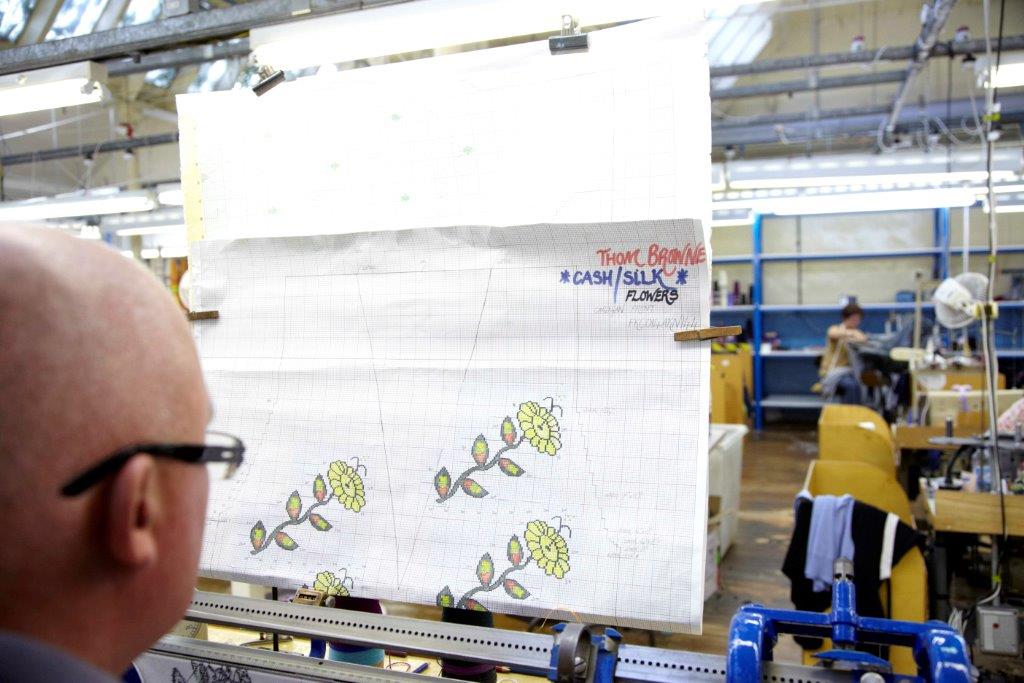

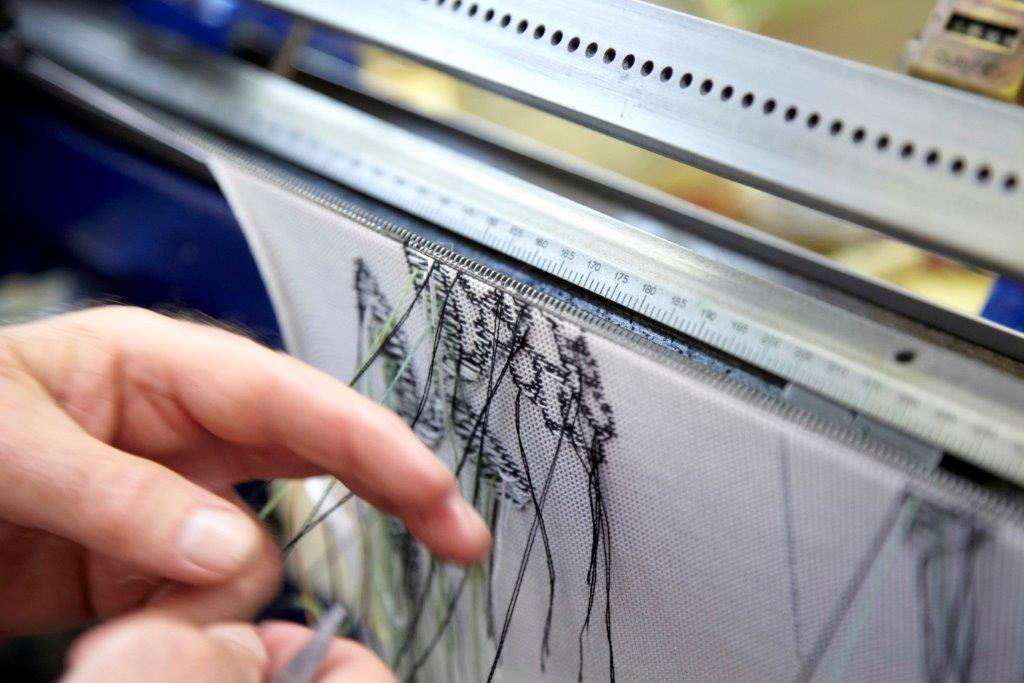
So the looms – the factory also knitted very high-quality plain knitwear – are silent and the hand intarsia frames stand idle.

All I can say is well done Tom Harkness and your talented colleagues for giving it a go. Fare thee well, lads and lasses. You deserved a better ending than this.

Poring over postcards with Tom Phillips
Thursday, June 6th, 2013
On May 24 I visited that fascinating man, eminent artist Tom Phillips CBE RA, at his home in south London and I was delighted to discover that it was his 76th birthday. By coincidence, I had celebrated my 58th birthday the day before.

It’s more than two years ago that we first met when he did me the honour of asking me to write a foreword to Menswear, one of a series of six books he has produced for Bodleian Library Publishing from his huge collection of picture postcards. We had a lovely party at Huntsman in Savile Row to launch Menswear.

Weddings is one of my favourites – such a poignant collection. How did those 200 marriages work out?

Tom has collected an amazing 50,000-plus of these photographic records in the past 35 years or so. I have learned that the neat books in the Bodleian Head series, which feature 200 postcard images of people, are only a small part of his prodigious output. I can recommend without hesitation his magisterial The Postcard Century, which came out in 2000 to celebrate the 20th century through two thousand postcards selected and annotated by Tom. You can read selections of the messages written on each of the 2000 cards – it’s an amazing work of 452 pages and costs barely £20.

More than 1000 postcards that show only people were gathered together by Tom at the National Portrait Gallery in the spring of 2004 for an exhibition called We Are The People. These largely unknown faces made a telling parade alongside the famous images of the great and good at the NPG. Included in the accompanying catalogue-book are postcards that feature Tom’s father (from around 1906) and his mother (from the early 1930s). Tom generously gave me a copy of the 336-page catalogue, which is quite a pricey collector’s item these days.

Tom’s postcard collection is filed into 120 categories (and some sub-categories) and is kept in ring binders at his house.


I am so happy to report that further volumes in the Bodleian Library series are in the pipeline. Walls and Sport are finished and Dogs is not far behind. Watch out for them.

With my personal fascination for Tom’s postcards, I sometimes forget that his main activity is art. Although he was born in 1937, he is clearly a workaholic and has described himself to me as “a slave to art”. His fascinating home certainly reflects his myriad interests. This is part of his downstairs study.


His main room for painting and drawing is on the first floor.


He sketches on the ceiling by attaching charcoal to a long stick.

His second workroom on the second floor overlooks a leafy back garden. This rooms houses those essential ring binders and is where Tom selects the images for his postcard books.


Practical as well as artistic, Tom uses a cricket bat in place of a missing balustrade. It’s that sort of house.

Sign up for The Musgrave Manifesto
Latest posts
- Black Ivy: A Revolt In Style
- Nino Cerruti’s personal wardrobe
- My top topcoats
- Fine Scottish knitwear from Scott & Charters
- The Modern Shetland Sweater by Skippers Mill
- Leeds Then And Now evolves
- Celebrating Sportswear International