The Musgrave Manifesto
Register to receive The Musgrave Manifesto in your inbox and let me know what you think.
Click on the images to enlarge them.
Use the arrows at the foot of the pages to move to other posts.
Favourite flannel & German 50s style
Thursday, May 30th, 2013
Idly flicking through my stash of copies of the venerable Tailor & Cutter magazine, I came across an example of recycling from more than 70 years ago.
This illustration of a striped flannel suit from the issue of 7 April 1939 was so good…

…that it was repeated with different copy for the issue of 23 May 1941, some 111 issues later. Note that the paper restrictions of wartime had forced the publisher to merge its Women’s Wear title with T&C, the menswear bible. Outfitting News was dropped from the masthead as a result.

By an odd coincidence, May 23 is my birthday, although I did not appear until 1955. Also produced in that momentous year was the copy of Herrenjournal, a German men’s trade magazine-cum-style journal, that carried these fine illustrations.

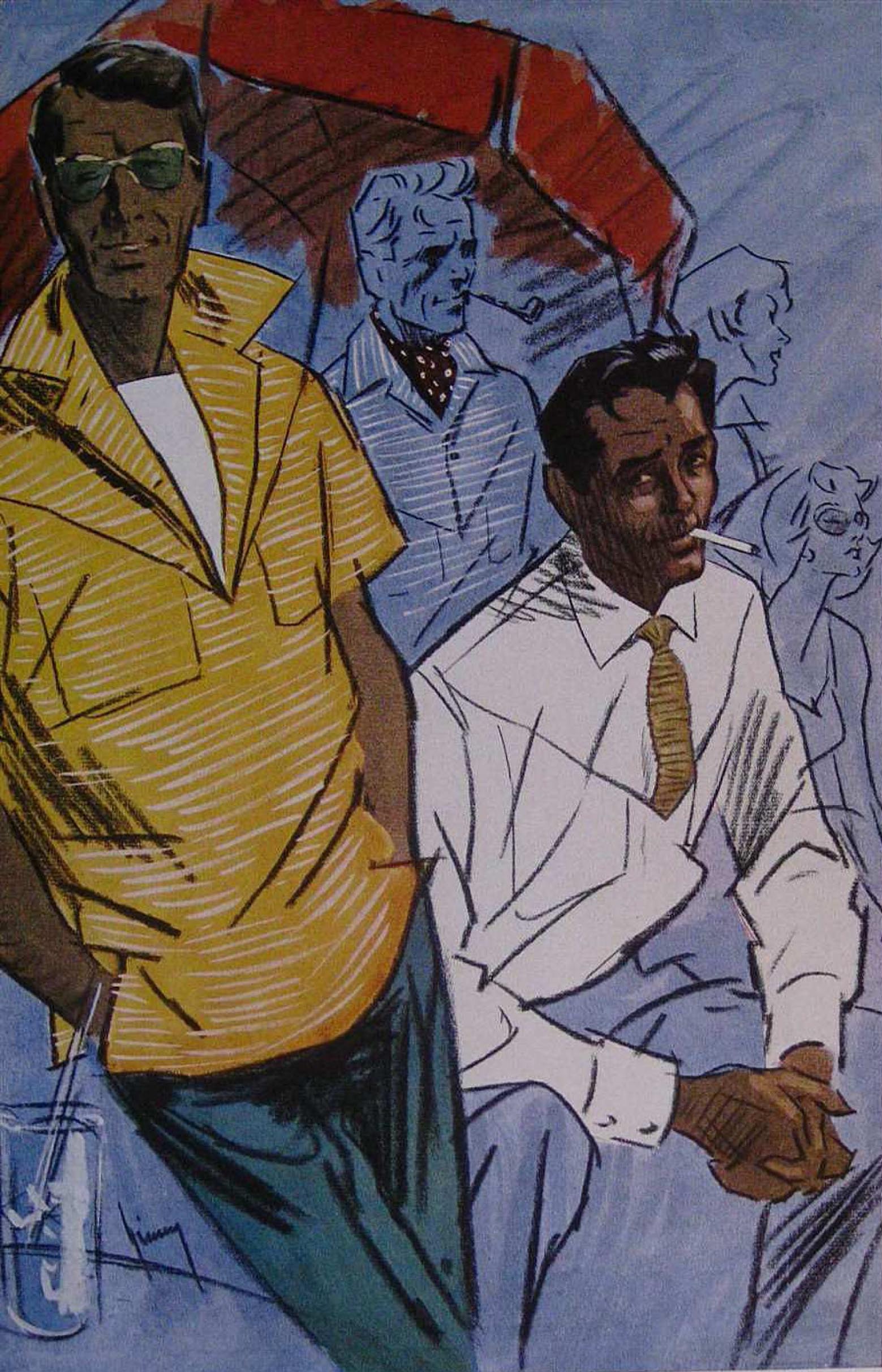


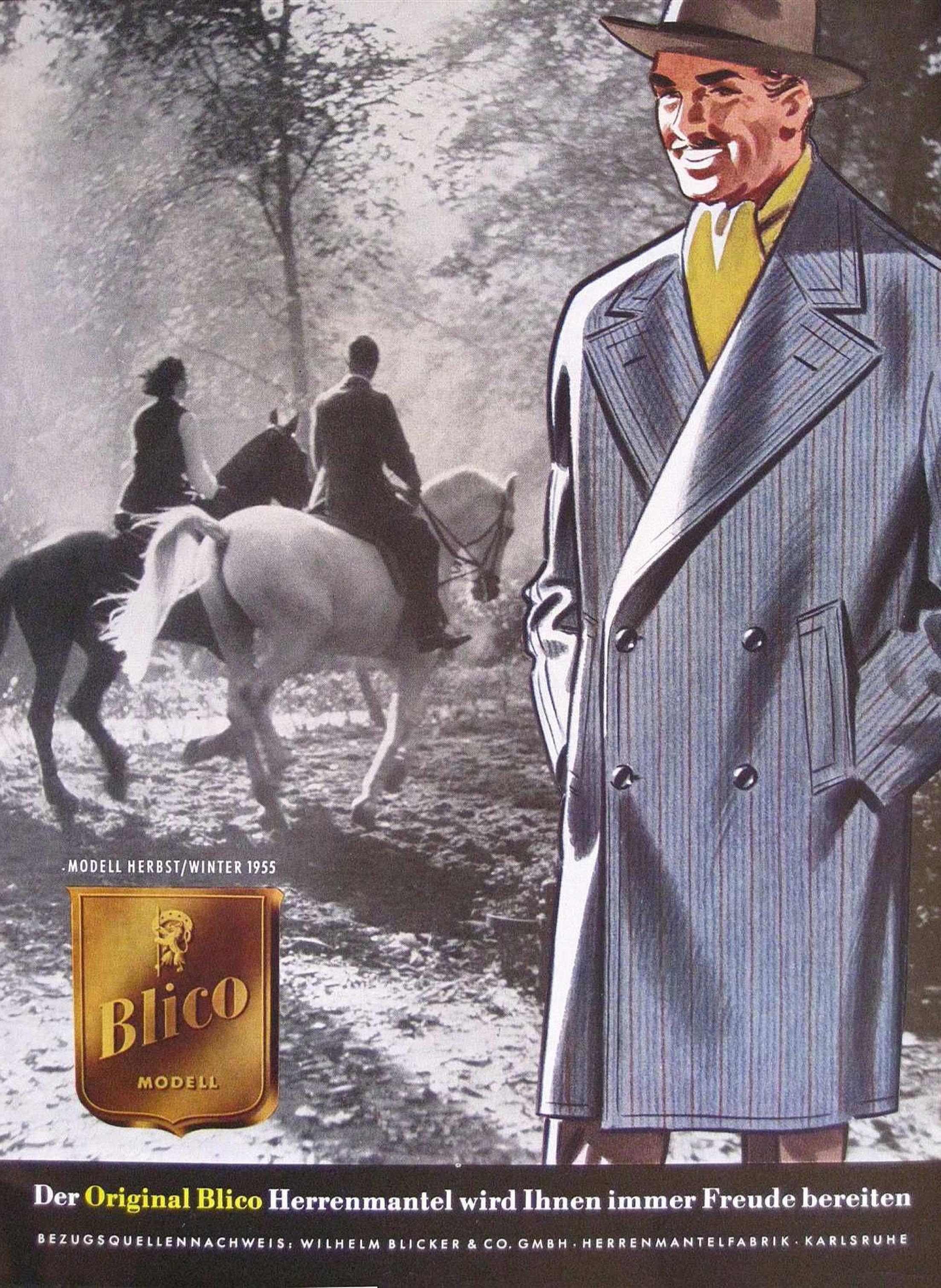
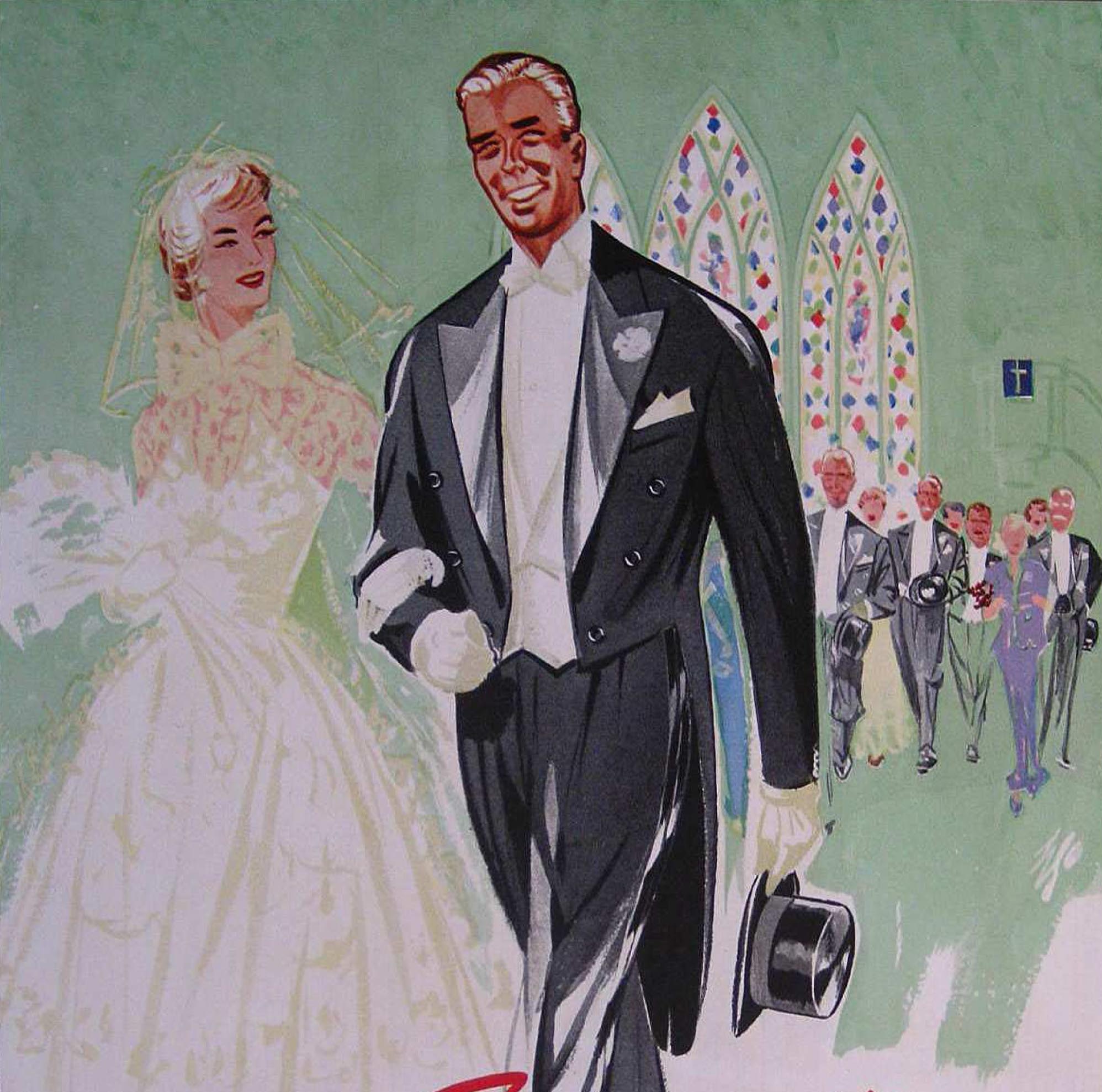
It was indeed a more elegant age. I particularly like the wedding images. My thanks go to Sven Raphael Schneider, the man behind Gentleman’s Gazette, for supplying me with a pdf of this fascinating magazine.
Celebrating dandies in Rhode Island
Wednesday, May 29th, 2013
Sitting very pretty on my bookshelf is this new book.

It’s a very handsome 194-page hardback that has been produced to accompany an exhibition of menswear at the Rhode Island School of Design in Providence. The event runs through until 18 August; all the details are here. The joint curators Kate Irvin and Laurie Anne Brewer are to be congratulated on bringing together a fascinating selection of historical and contemporary men’s clothes.
Among the many images I like in this sumptuously produced volume is this close-up of part of a three-piece suit made in 1968 for the American author and dandy Richard Merkin. The tailor was F L Dunne and Company of New York and Boston; Merkin donated the suit to the RISD Museum in 1999.

The book carries four long academic pieces on aspects of menswear, surrounded by shorter pieces by a range of authors on notable dressers they admire. Mark Samuels Lasner, senior research fellow at the University of Delaware Library, chose the writer and cartoonist Max Beerbohm as his subject. This 1947 portrait of Beerbohm was taken by Douglas Glass.

Motofuni “Poggy” Kogi is a buyer and director of United Arrows, the Japanese menswear chain. He was the choice of Derrick Miller, creative director of the Barker Black shoe line and of Miller’s Oath, a luxury men’s shop in Greenwich Village, New York.

Ignacio Quiles owns a vintage menswear business called QP & Monty in Greenwich Village and writes an entertaining blog under the same name. He was photographed in 2011 by Bill Gentle.

Waving the Dandy banner for Britain is Guy Hills, flamboyant and talented partner in the London-based Dashing Tweeds cloth business with Kirsty McDougall. Guy’s sometime collaborator James Sherwood wrote a fine piece on him. the photograph is by Geordie.

Huge thanks go to my friend, bespoke tailor Kathryn Sargent, who brought the book back from the US for me. She appeared during the opening proceedings at the RISD talking about her work and some of her fine outfits are included in the exhibition.

Even the back cover of the book is well-dressed. Artist/Rebel/Dandy: Men Of Fashion is published by Yale University Press, with essays by exhibition curators Kate Irvin and Laurie Brewer, fashion historian Christopher Breward, and Barnard College English Professor Monica L. Miller; a preface by menswear designer Thom Browne; and “musings” on artist-dandies by 15 contributors, including Glenn O’Brien (Beau Brummell), Patti Smith (Charles Baudelaire), Merlin Holland (Oscar Wilde), Horace Ballard (W. E. B. DuBois), and Scott Schuman (Luciano Barbera). If you like quality menswear, you will like this book.
Footwear retailing, Dubai-style
Thursday, May 23rd, 2013
Despite my long-standing concern with clothes, it’s only in recent years that I have been particularly interested in shoes. I am not a keen shopper either, but despite these two relative reservations, even I was pretty damn impressed by Level Shoe District, reputedly the world’s largest premium footwear emporium. It covers 96,000 sq ft within The Dubai Mall, the vast shopping centre in downtown Dubai.


The creation of The Chalhoub Group, which has been involved in retail, distribution and marketing of premium products since 1955, Level (or level, as it is officially styled) replaced an unsuccessful attempt to recreate a traditional gold market or souk in The Dubai Mall. It was opened on 12 October 2012. The main buyer for the concept store is Alberto Oliveros, who previously looked after accessories for Ralph Lauren Europe. he’s seen here in the men’s multi-brand section.

There are something like 250 brands in the store, which together offer about 30,000 styles. Alberto does not buy many examples of each style, but, even so, he told me that there are about 300,000 pairs of shoes (yes, three hundred thousand) in stock at the height of the season. The stock rooms, which are located at the perimeter of the area, are very well organised, he assures me.
Level is divided into four main sections: Women’s Designer;


Women’s Contemporary;


Trend;


Men’s:


As well as the multi-brand areas, Level also boasts about 40 separate stores, one of which is Corthay’s contemporary boutique.

The individual boutiques are situated around the perimeter of Level, while the multi-brand areas are situated on the main floor. The look of Level was created by Shed, a London-based interior architecture and design agency. Nice going, guys! You even impressed someone as jaded as me.
A Parisian Gentleman in Dubai
Tuesday, May 21st, 2013
On last week’s trip to the UAE I was delighted to make the acquaintance of Hugo Jacomet, who is the clever fellow behind the Parisian Gentleman website, which I can recommend wholeheartedly to anyone who is interested in quality menswear and related topics. Beware though, it can become rather addictive as there is lots of good stuff on there (in seven languages!)

Hugo was on the Maison Corthay trip as he is a good friend of the company. He has made a lovely short film for Corthay called La Beauté du Geste (The Beauty of the Gesture), which features a fascinating collection of Swiss artisans, such as a cello maker and a traditional cuckoo clock manufacturer. Hugo introduced the film at Corthay’s Dubai party and I hope it soon is made available for wider viewing.
My thanks for wielding the camera for the above pic goes to Sonya Glyn Nicholson, Hugo’s charming partner-in-life and the author of many very readable features on Parisian Gentleman.

Hugo was kind enough to post my blog on the Al Khaznah camel leather tannery on his site. You can read it here.
Corthay’s Dubai party
Sunday, May 19th, 2013
The social focus of my recent trip to Dubai and Abu Dhabi was a very pleasant reception given by Maison Corthay, the French luxury footwear brand, or as its slogan states, the contemporary Parisian bootmaker.

Our host was Xavier de Royere, the president of the company, which was set up by master shoemaker Pierre Corthay in 1990. Xavier heads a group of new investors who have funded global expansion for Corthay from its main store at 1 rue Volnay in Paris’ 2nd arrondisement. Xavier is well known in the luxury sector in the UK as he used to run Louis Vuitton’s retail interests over here before taking up the role of CEO of Loewe, the Spanish luxury group. Beautiful footwear for men is now his passion.

The location for the party was The Pavilion, a striking art space in downtown Dubai. Appropriately enough, the Corthay styles were displayed as works of art.

Corthay’s shoes are made in a workshop just outside Paris, using exclusively the classic Goodyear welted construction. The company’s best-selling style is called Arca, which was the name of Pierre Corthay’s grandfather’s yacht on which he sailed as a child. These are the new camel leather versions.

Although you can order bespoke Corthay shoes, even its ready-to-wear styles – which start at about £940 in the UK – are almost always customised to suit a customer’s requirements. I really like the chic contrast piping, which is a Corthay trademark.

High-gloss finishes is another specialty of the company and, as usual at Corthay events, a member of staff was on hand to demonstrate the remarkable skills of colouring and polishing.


If your budget stretches to £6,000 and beyond, even exotic skins like crocodile can be given the Corthay treatment. Note how regular the size of the scales are.

Happily for a fan of suede like me, the company also does versions in a great looking matt finish.

Predictably enough, I found myself strangely attracted to this flamboyant version of the Arca.

Among my fellow scribblers on the trip were Nick Scott, editor of The Rake magazine, and a fine fellow who commissions me on a regular basis. A new friend for me was Vincenzo La Torre, deputy editor of Prestige magazine in Hong Kong, who greatly impressed me with his ability to speak Japanese fluently.

Vincente chatted away furiously to Yukihio Sugawara, editor-in-chief of Last, a Tokyo-based magazine devoted to men’s footwear. Yuki’s English is a lot better than my non-existent Japanese. For the party, I wore my seersucker jacket by French brand Hartford and lilac cotton trousers from Club Argentina, a small chain in Paris, but I waved the flag for British style with my shirt and pocket square from Penrose London. My shoes – purple suede slip-ons – are from Oliver Sweeney. My new glasses from Silhouette completed the look.

It is almost impossible to find anything old in Dubai, so it was good to see this handsome Rolls-Royce parked outside the gallery. It was a classy accessory for a classy event.

Corthay’s camel leather creations
Friday, May 17th, 2013


The grainy leather of these handsome men’s shoes is camel skin. The French luxury bootmaker Maison Corthay this week took me to the United Arab Emirates to see where it sources this interesting and unusual leather. It was a fascinating trip.

It takes very little time to escape the futuristic concentration of downtown Dubai and find yourself in the desert. We drove south-east into Abu Dhabi for about two hours, where very occasionally we’d spot a few wandering dromedary camels. The legendary “ship of the desert” has been domesticated for about 5,000 years and most of the locals here – it is true Bedouin country – keep at least a few camels. As well as being raised as a means of transport or for racing, the camel provides dairy products (you can buy camel milk chocolate in the UAE) and meat.

The Al Khaznah Tannery, which is surrounded by sand dunes in what appears to be the middle of nowhere, was set up by the Abu Dhabi government in 2003 to process the by-products of the camel meat trade. It is a compact processing unit of about 75,000sq ft (7,000sq m) that employs 84 people to produce about 5.3m sq ft of leather each year. Some 80% of the production is of camel skin, with the rest being shared between cow, goat and sheep. The plant is extremely eco-friendly, with a fully integrated system for re-cycling the many gallons of water that are used in the tanning process. It is one of only four tanneries in the world to recycle its water.
Most importantly, the tanning process at the plant is claimed to be unique, being free of the chrome and aluminium commonly used in tanneries. The technically advanced leather produced here is also biodegradable, which is not the case with conventionally-tanned skins.The tannery general manager is Jean-Marie Gigante, a Frenchman who used to work for Hèrmes, and the operations manager is Wolfgang Schmälzle, a German with three decades of experience in tanneries around the world. For the detailed story of the tannery, I recommend a visit to its website. Monsieur Gigante, who clearly knows his stuff, describes camel skin as “a leather and a half”.
The skins arrive from a nearby slaughterhouse and are wet and salted to begin the process of removing the outer hair. These are goat skins (sadly no raw camel skins were on show the day we visited).

The entire tanning process takes about 10 weeks and it takes three to four days just to dissolve the hair and prepare the material for the tanning process. The bare skins look and feel like dirty versions of a wash leather. Despite the sophisticated mechanisation of the process, tanning is still a labour-intensive industry as every skin has to be handled and arranged at various stages in the process.


The natural and sustainable extracts used in the eco-friendly tanning process are added in these drums or “reactors”. The skins have to be of a similar size or the larger ones will absorb more of the extracts than the smaller ones. Camel skins tanned here can vary from about 2sq ft to 20sq ft in size, depending on the age of the animal and how the hide has been cut, so sorting them is another labour-intensive task.


The tanned skin can be left in a pile on a pallet to “pickle” or “age” for a time to give it more character. Many subtleties can be applied to the whole process. Camel hide is typically 2-3mm thick, which is too much for most end-uses, so it is sliced horizontally or “split”. The skin that was nearest the carcass is called a “split” and is commonly used to produce a cost-effective alternative to real suede leathers. The outer level is the more valuable and goes into Corthay’s high-quality shoes. These images show the skins before and after splitting.


The uneven split hides are then shaved to a uniform thickness to a tolerance of only 1/10th of a mm – a gauge is used to check that the thickness is consistent.


As mentioned above, water is a constant ingredient of the tanning process and before the leather is finished, most of the moisture has to be removed. Gently pressing the hides through a heated roller is the first stage and then the skins are hung up for a leisurely tour of part of the plant on an overhead conveyor system to dry naturally. It is essential that the skins retain around 8-10% moisture – we all know the horrible damage caused when shoes are dried out too aggressively after a soaking in the rain.


One of the distinct attributes of camel leather is its natural grain, as seen here, before the skin is finished. The older the animal, the more pronounced the grain.

Among the many and varied finishing stages is the application of colour. The skins are dyed in bulk in drums, while individual finishes, like a high-gloss or patent coating, are done individually. There is no shortage of options at Al Khaznah.


The tannery was conceived under the instructions of the BLC Leather Technology Centre in Northampton England, which is one of the arbiters of leather standards worldwide. Its camel skins are widely used in the aviation industry, which is particularly demanding on the quality and performance of leather for aircraft seats. The lab at the tannery performs constant quality control tests for qualities such as resistance to abrasion, water-resistance and tensile strength. Camel hide has about 10 times more fibres in its construction than bovine hide, making it appreciably stronger, despite it being very soft and supple. In the standard test tearing test for respective leathers, cow hide ripped under a force of 240 newtons (the amount needed to accelerate 1kg of mass at the rate of 1m per second squared), while a comparable sample of camel hide finally ripped under a force of 725 newtons, making it three times as strong as cow leather.


Our short visit to Al Khaznah was a fascinating eye-opener for me to all the work and expertise that is needed to prepare leather even before it is used in any finished goods. I suspect that very few consumers know much about shoe construction; even fewer would have a clue about what had gone into getting camel skin from the animal’s back to the luscious soft, strong and seductive skin that goes into Maison Corthay’s shoes.


The French brand has used the camel skin in its best-selling Arca style, which is a signature design by company founder Pierre Corthay. The camel style comes in four colours – black, white, cognac (a reddish brown) and light brown. It was launched in Corthay’s Dubai store last October as a salute to the region’s heritage, but this season it will be available at all Corthay stores worldwide, including the branch at 24A Motcomb Street, London SW1 8JU, close to Harvey Nichols. The camel leather shoes retail for around £1,000 – £1,100, at only a small premium to the standard Arca in calf leather, which starts at £940.
The bright lights of Dubai
Tuesday, May 14th, 2013
Thanks to the generosity of French luxury footwear firm Maison Corthay, I am able to share with my readers the view from Room 3307 of The Address Downtown Dubai Hotel, which faces the extraordinary Burj Khalifa, the tallest building in the world, which soars an incredible 2,716.5 feet (828 metres) into the sky.


While the view from 33 floors up is impressive, it cannot compete with the view from 122 floors up. The tall white tower in this pic is indeed my hotel, as seen from the At.mosphere bar in Burj Khalifa, At 1,447ft 10in (441.3m) above sea level it is the highest restaurant-bar in the world.


Luckily I did not spend all my time in the air. Watch for subsequent blogs for my route to the Maison Corthay store in Dubai Mall, via a camel skin tannery, the skins from which go to make these very desirable shoes with the pronounced grain…


Power & Style: a sumptuous volume
Monday, May 6th, 2013
I am much enjoying a recent addition to my library: Power & Style – A World History of Politics and Dress by Dominique and François Gaulme. This French wife-and-husband team have produced a 288-page masterpiece that examines the role of men’s dress and power from ancient times. François is an anthropologist and historian and his wife is a former journalist for Figaro Magazine, so this is a very learned but readable work.The many images are also very impressive and well chosen, as this small selection illustrates.
The cover sets the tone. It shows a tunic made in c 1912 by Hawkes & Co (now Gieves & Hawkes) for Albert Edward John Spencer, Viscount Althorp, captain in The Life Guards and later the seventh Earl Spencer, paternal grandfather of Diana, Princess of Wales and maternal great grandfather of Princes William and Harry. The tunic is in the Gieves & Hawkes archive, which is on show at its 1 Savile Row flagship.

From the opening chapter, Naked Societies, a portrait of Sioux warrior Turning Bear from around 1900 in a photograph by John Alvin Anderson.

A modern example of regal splendour: Ngie Kanga Joseph, fon or king of Bandjun, Cameroon, photographed by Daniel Lainé.

From the days before photography, Joachim Murat in a Hussar’s Uniform, 1801, by François Gérard. Not the astonishing decoration on this outfit, all done by hand in those days.

From the chapter on King Edward VII, a photo of the future king when Prince of Wales (on the extreme left) with his elder son Albert Victor, Duke of Clarence (extreme right), and two of Edward’s brothers, Arthur, Duke of Connaught, and Leopold, Duke of Albany. This photo was probably taken in the 1880s as Albert Victor died of influenza in January 1892, aged 28.

Edward’s nephew, Kaiser Wilhelm II, in 1894 wearing the most beautiful gloves and sporting the most spectacular fur muff.

From the chapter on Totalitarianism, Lin Pao and Mao Zedung on the 20th anniversary of the People’s Republic of China, 1969. The Great Helmsman is wearing a now very fashionable workwear tunic. I like the matching cap too.

From the same chapter, Adolf Hitler photographed by Heinrich Hoffman around 1926-27. Apart from the Nazi insignia, it is a great example of a southern German traditional costume, one which is often seen in Bavaria today. The best lederhosen (literally leather trousers) are made of pig suede or deer hide.

Joseph P Kennedy, Sr and his sons Teddy, John, Joseph Jr and Bobby at their Hyannis Port home in the 1930s, from the chapter on American Style. JFK was dapper even as a teenager.

A superb pic of Warren Beatty in about 1967 wearing a Cartier Tank watch and white loafers.

The most powerful man in the world is not the most stylish, but Barack and Michelle Obama make a good-looking couple here, in Washington DC on Inauguration Day, January 20 2009.

To counterbalance the cover, a guardsman – obviously a high-ranking one – photographed at Queen Elizabeth II’s Diamond Jubilee celebrations in 2012.

Power & Style – A World History of Politics and Dress is published by Flammarion, with a cover price of £50. My thanks go to Simon Baker at Gieves & Hawkes for sending me this brilliant book. I can recommend it wholeheartedly.
I’ve been framed by Silhouette
Thursday, May 2nd, 2013
It’s been a few weeks since my visit to Silhouette’s London HQ for a session with the Austrian eyewear company’s stylist Angelica Pagnelli. The fruits of our discussion have now been delivered to me.
Most like my usual style are these rather delicately proportioned frames, known officially as the Titan Impressions Full Rim, Model 2879. Like all the Silhouette frames, they are exceptionally well constructed and extremely light, so are very comfortable to wear. The plastic material used for the frames is called SPX and has been patented because of its lightness, colour adaptions and hypoallergenic properties. My pair is in Red Energy (Silhouette Colour no. 6053) and I particularly like the delicate translucent quality – strong sunlight really makes them appear to glow from within. The approximate price of the frame is £250 (not including lenses).


Most unlike my usual heavy frames is this trademark Silhouette rimless model, officially the Titan Minimal Art. The Icon. The lens number is 5242 and the colour is Bordeaux Flair (Silhouette Colour no. 6062). This frame (not including the lenses) is about £270. These are definitely the most high-tech spex I have ever worn, being light, flexible and durable. The titanium is so flexible that the frames require no hinges or screws – they are a remarkable example of precision engineering and are so incredibly light that I am scarcely aware of wearing them. I am enjoying the extreme change from my typical large frames, but other people have said I am missing my trademark. The debate continues…


Reverting to a more obvious style, my sunglasses are the Silhouette Aviator, Model 8657, Colour no. 6205. In the normal format the lens is green, but Silhouette kindly put prescription lenses in these and the other two models, so the lens here is grey. The non-prescription model is about £200. Once again, these highly engineered sunnies are very light to wear and give superb protection from strong sunlight while allowing excellent vision. They arrived just in time for the recent burst of good weather and I am hoping to get a lot of wear from them this spring and summer.


My thanks go to the patient efforts of Silhouette’s ophthalmic consultant Dilip Darjee, who measured me for my varifocal lenses and adjusted the frames when they arrived

and Silhouette UK’s marketing manager Jeremy Lanaway, who wears the product well himself.
Sign up for The Musgrave Manifesto
Latest posts
- Black Ivy: A Revolt In Style
- Nino Cerruti’s personal wardrobe
- My top topcoats
- Fine Scottish knitwear from Scott & Charters
- The Modern Shetland Sweater by Skippers Mill
- Leeds Then And Now evolves
- Celebrating Sportswear International